


Protect your investment
After spending thousands of dollars on your new piano, it makes sense to make sure it lives in an environment that won't do it any harm. If you have an acoustic piano, taking the best possible care of it will bring you enormous satisfaction. The most important factor to take into account is the environment of the room it's in. Once you've properly placed your piano away from a radiator and direct sunlight, the ambient humidity must be taken into account. When acoustic pianos are exposed to high or low relative humidity, or large and rapid variations in humidity, significant pressure changes can occur on the wooden soundboard. These changes can cause the instrument to malfunction, or even crack: so it's important to ensure that your piano remains in an ideal indoor climate. A good maxim to follow for the survival of these "living" instruments: if you're well, your piano will usually be well too.
Ambient conditions
Like us, wood and felt are very sensitive to extreme changes in temperature and humidity. During the heating period, a good-quality standard humidifier should be used to control and regulate humidity. The most favorable environment for your piano is a relative humidity of between 40% and 55% and a constant temperature of approx. 20-24 ° C. Sudden temperature fluctuations should be avoided, as they could adversely affect the setting and control. For underfloor heating, please contact us directly for further information.
Location
Choose a location with good atmospheric conditions; preferably against the inside wall of a room, not near windows or exterior doors. During the heating season, your piano should be kept away from all sources of heating systems. The surface of your piano is very sensitive to sunlight, so be sure to keep it out of direct sunlight. Special castor supports protect your floor covering. When not in use, make sure the top of your instrument is closed to prevent the accumulation of dust inside.
Keyboard
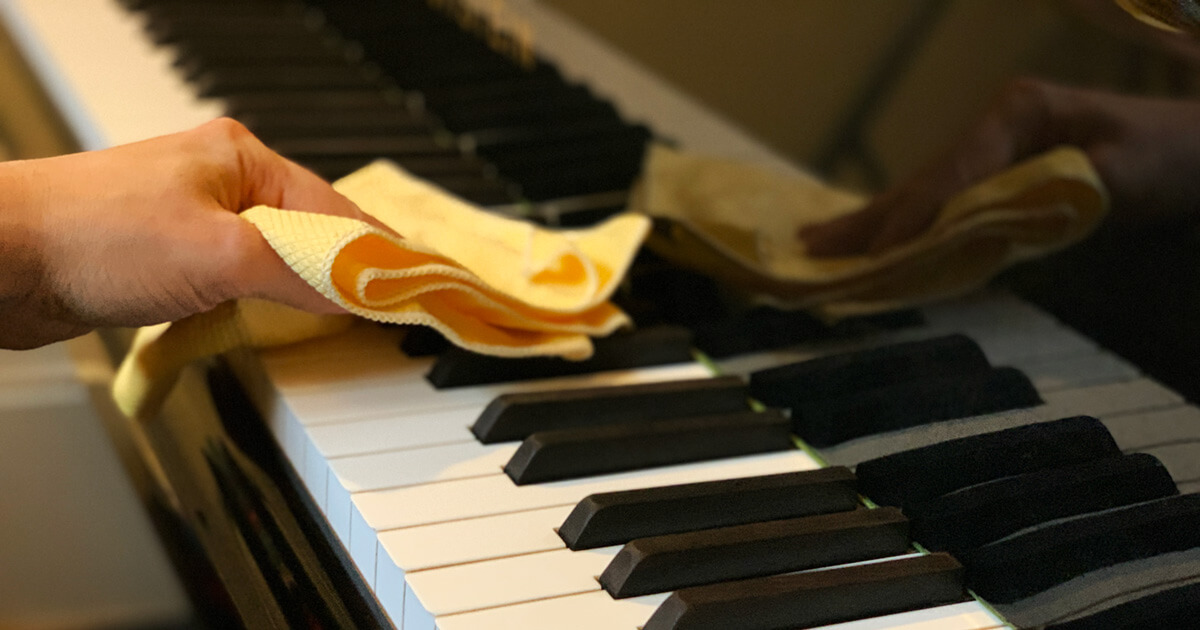
Use a lightly dampened natural chamois or microfiber cloth to clean the keys. Make sure no moisture runs down the sides of the keys.
Surface treatment
Whether polished or satin-finished, your piano should only be wiped with a soft microfiber cloth or a slightly dampened natural chamois cloth. We strongly advise you not to use furniture varnish, as it contains waxes and in some cases silicone. Any subsequent treatment of a badly scratched surface is quite costly.
Setting
The correct pitch (440 Hz = concert pitch) is set by adjusting the string tension. We recommend frequent adjustments during the first year, as the organic materials have to adapt to the immense tension. It usually takes a year for a new piano to "settle in" and find its balance. Thereafter, your piano should be tuned at least once a year, even if it is rarely used. Two tunings a year are strongly recommended. Pitch must be maintained at a constant level: imagine that a tiny difference in tension on one string, when passed on to the hundreds of strings on a piano, results in considerable variations in total tension.
Control
Regulation is the adjustment of the action and should be carried out at regular intervals, to ensure optimum uniformity of touch and play. Even if ambient conditions are satisfactory, adjustments should be made at regular intervals.
Harmonization
The character of each individual note is formed either by pricking or by spraying fixative into the felt of the hammers. Establishing and adjusting a piano's "voice" in this way requires in-depth expertise and should be left to a licensed piano technician. It should be noted that this type of work is in no way required for the piano to function properly; rather, it is a possibility for musicians seeking to further personalize their instrument.
Summary recommendations
The essence of piano care is to maintain the piano in a favorable environment, so that the moisture content of the wood is maintained throughout the life of the piano. Maintaining a favorable environment can be difficult in a northern country. That's why we strongly recommend that an automatic humidity control system (Dampp-Chaser) be installed on your piano to avoid humidity-related damage and to ensure the playability, longevity and value of the instrument. Please consult our service department for detailed information on this subject.


